01 The Man Long Beach · 1923
Nels John Bandy
He was twenty years old when he shipped out for Europe in February 1944, and twenty-two when he came home in November 1945.
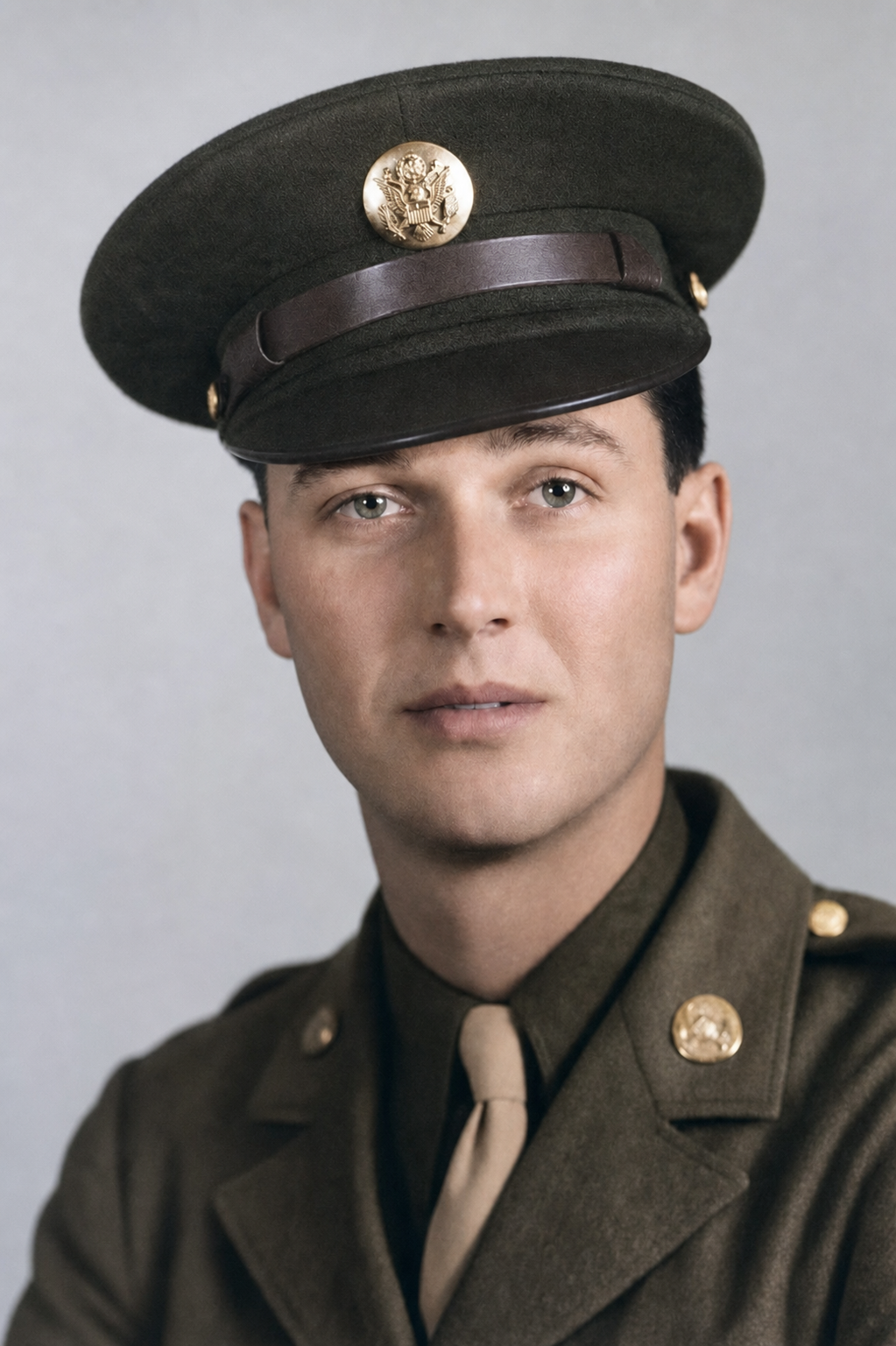
Nels John Bandy was born on March 29, 1923, in Long Beach, California. He shipped out a twenty-year-old and returned at twenty-two, having served through much of the war in Europe in between.
He was discharged on November 25, 1945, at Fort MacArthur in San Pedro, the Army post that had guarded the harbors of Los Angeles and Long Beach since 1914, near where he had grown up.
Nels lived nearly sixty-eight more years after the war. He died on February 16, 2013, in Valencia, California, at the age of 89, and was buried under the care of Eternal Valley Memorial Park & Mortuary in Newhall.
| Rank | Corporal |
|---|---|
| Unit | 535th Anti-Aircraft Artillery Automatic Weapons Battalion, B Battery |
| MOS | Anti-Aircraft Range Section NCO |
| Born | March 29, 1923 · Long Beach, California |
| Departed U.S. | February 11, 1944 |
| Arrived Europe | February 22, 1944 |
| Returned | November 10, 1945 |
| Discharged | November 25, 1945 · Fort MacArthur, California |
| Campaigns | Normandy · Northern France · Ardennes · Rhineland · Central Europe |
| Died | February 16, 2013 · Valencia, California · age 89 |
02 His Job Range Section NCO
The Brain of the Gun Position
Nels’s military occupational specialty made him a non-commissioned officer of a range section in an automatic-weapons battalion. A battalion of this era was built around four firing batteries, A through D, each fielding 40mm Bofors automatic cannons paired with M51 quad-mount .50-caliber machine guns: four heavy machine guns on a single powered turret, a weapon GIs came to call the “meat chopper.”
The range section was the brain of the gun position. Its men operated the sighting and fire-direction equipment that measured a target’s range, altitude, and speed and translated it into firing data for the guns, work that demanded mathematics and speed while aircraft bore down on the position. As the section’s NCO, Nels supervised that work: a corporal responsible for the guns firing accurately when seconds mattered.
03 The Route 1943 – 1945
From the Mojave to the Rhine
Eight stops across two years and two continents, tracing the war in Northwest Europe.
-
Camp Haan & the Mojave, CA
Trained 1943 – Feb 1944 -
Cannington, Somerset
Staging · Feb – May 1944 -
Utah Beach, Normandy
D-Day · 6 June 1944 -
Northern France
Pursuit · Summer 1944 -
Elsenborn Ridge, Belgium
The Bulge · Dec 1944 -
Remagen, Germany
Rhine crossing · 10 Mar 1945 -
Central Europe
Ruhr · Danube · to V-E Day -
Fort MacArthur, CA
Discharged · 25 Nov 1945
04 The Battalion Camp Haan & the Mojave
Battalion from the Mojave
The 535th trained at Camp Haan, near Riverside, California, and in the Mojave Desert, close to home for a battalion filled with Southern California men like Nels. The unit’s own published history is titled, literally, Battalion from the Mojave, issued in two volumes. Copies still circulate among collectors and veterans’ families, and Volume 2’s appendix roster is where Nels is confirmed by name, in B Battery. This family has built a private digital edition of both volumes from personal copies.
The anti-aircraft mission
Anti-aircraft automatic weapons battalions were the mobile shield of the field army. They moved with the front, attached to divisions and corps as needed, and their guns protected beaches, bridges, artillery positions, supply columns, and infantry against the Luftwaffe. When enemy aircraft were absent, their weapons were frequently leveled at targets on the ground; the quad-.50 in particular proved devastating against attacking infantry. The AAA man’s war was one of constant movement, digging in, and scanning the sky.

05 Crossing Over England · Feb – May 1944
An English Spring Before the Storm
Nels departed the United States on February 11, 1944, and arrived in Europe on February 22, an eleven-day Atlantic crossing in the crowded, blacked-out holds of a troopship, zig-zagging against the U-boat threat in winter.
The 535th’s camp in England was Brymore House in the village of Cannington, Somerset, in the farm country of England’s West Country. There the battalion spent the spring of 1944 in final training and staging for the invasion. Cannington’s parish church holds a memorial to the 535th to this day, and one of the battalion’s temporary buildings stood in the village into the 2010s. The battalion left Cannington for the marshalling areas at the end of May 1944.
B Battery, Nels’s own, crossed the Channel aboard an LST as part of the invasion convoy. The battery’s medical officer, Capt. Heinke, later described the moment the order came down: rifles cleaned and recleaned, knives sharpened, medical supplies checked and rechecked. Just before midnight on June 5, a general-quarters signal summoned the men to battle stations for the crossing.
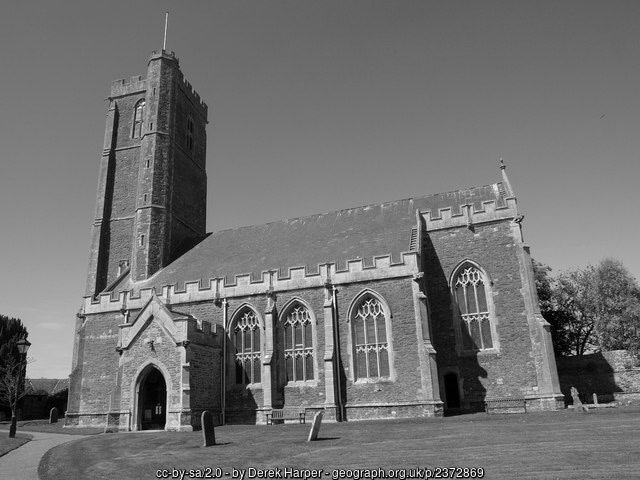
“‘Tomorrow is the Day,’ the word came down and with that word activity increased tenfold.”Capt. Heinke, B Battery medical officer, aboard the invasion convoy, 5 June 1944
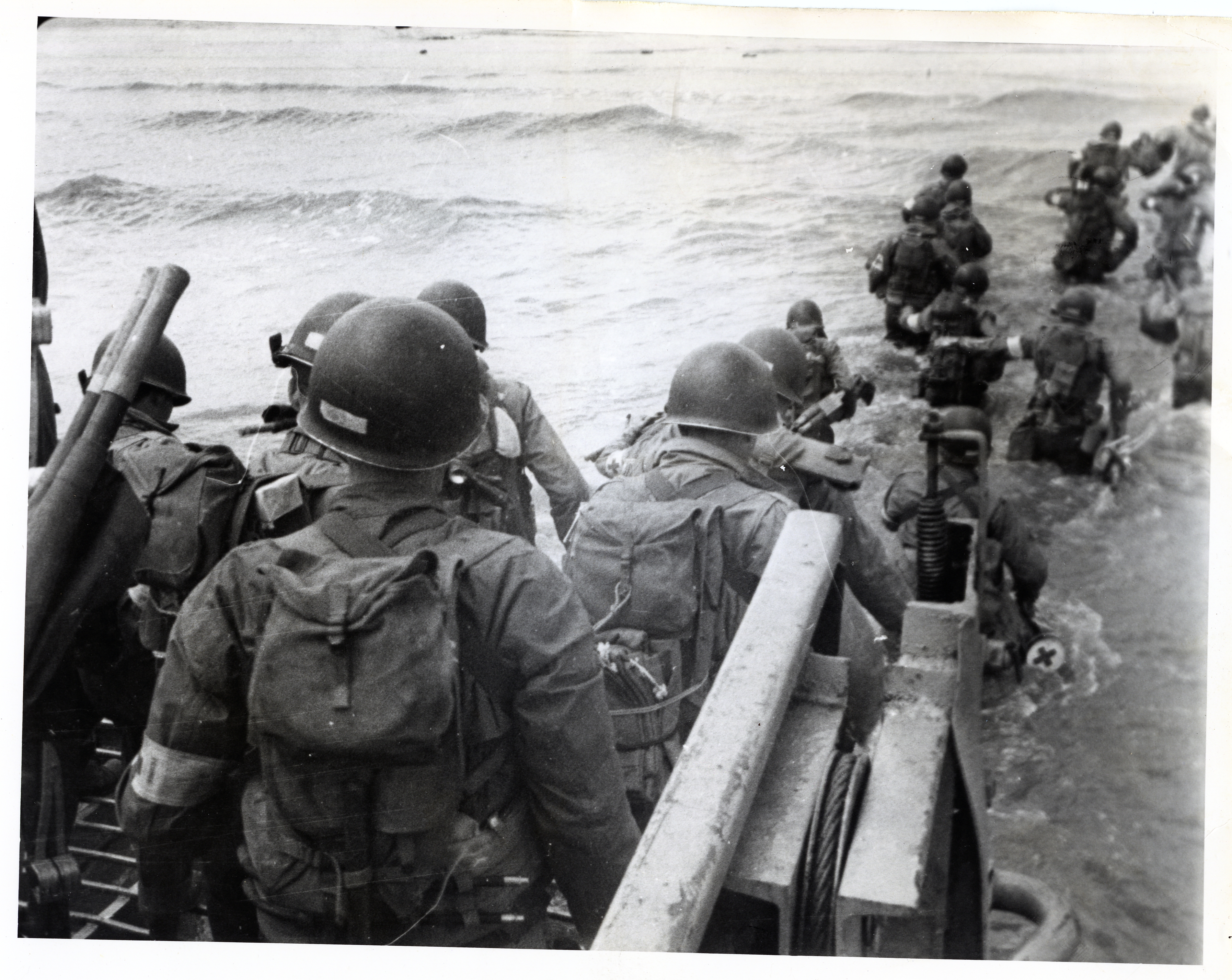
“The assault waves go ashore.” Utah Beach, 6 June 1944.
06 D-Day Utah Beach · 6 June 1944
The Longest Day
The 535th AAA AW Battalion landed at Utah Beach on D-Day, June 6, 1944, the westernmost of the five invasion beaches, on the Cotentin Peninsula of Normandy. Nels’s Bronze Service Arrowhead is the Army’s formal certification that he personally participated in an amphibious assault landing.
At Utah, H-Hour was 6:30 a.m. The naval bombardment began at 5:50, the 4th Infantry Division’s assault waves went in behind amphibious tanks, and paratroopers of the 82nd and 101st Airborne had been fighting inland since the small hours. Strong currents pushed the first waves some 2,000 yards south of their intended sector, a mislanding that, by luck, put them opposite weaker defenses. Brigadier General Theodore Roosevelt Jr., walking the beach with a cane, made the famous decision.
By the end of the day more than 23,000 American troops had come ashore at Utah. The anti-aircraft gunners’ task began the moment they hit the sand: get the guns off the landing craft, through the surf and the beach obstacles, into position, and put fire over the beachhead. The Luftwaffe came mostly by night in the days that followed, raiding the anchorage and the beaches, and the AAA battalions fired back into the dark. Nels was there on D-Day, at the age of twenty-one.
B Battery’s own landing came later that same day. Capt. George Dickerson, the battery’s CO, came ashore near La Madeleine around 5 p.m.; the battery’s second platoon followed about 8:30 p.m., landing under fire the battery’s own journal described as “still under heavy enemy artillery fire” — the first firing battery of the 535th to reach the beach. (B Battery’s first platoon would not land until 10 p.m. the following evening.) That night, as No. 8 gun section worked to emplace its 40mm gun, a mine exploded, killing five men — Townsend, Lones, Critchfield, Cannizzaro, and Ballard — and wounding four others.
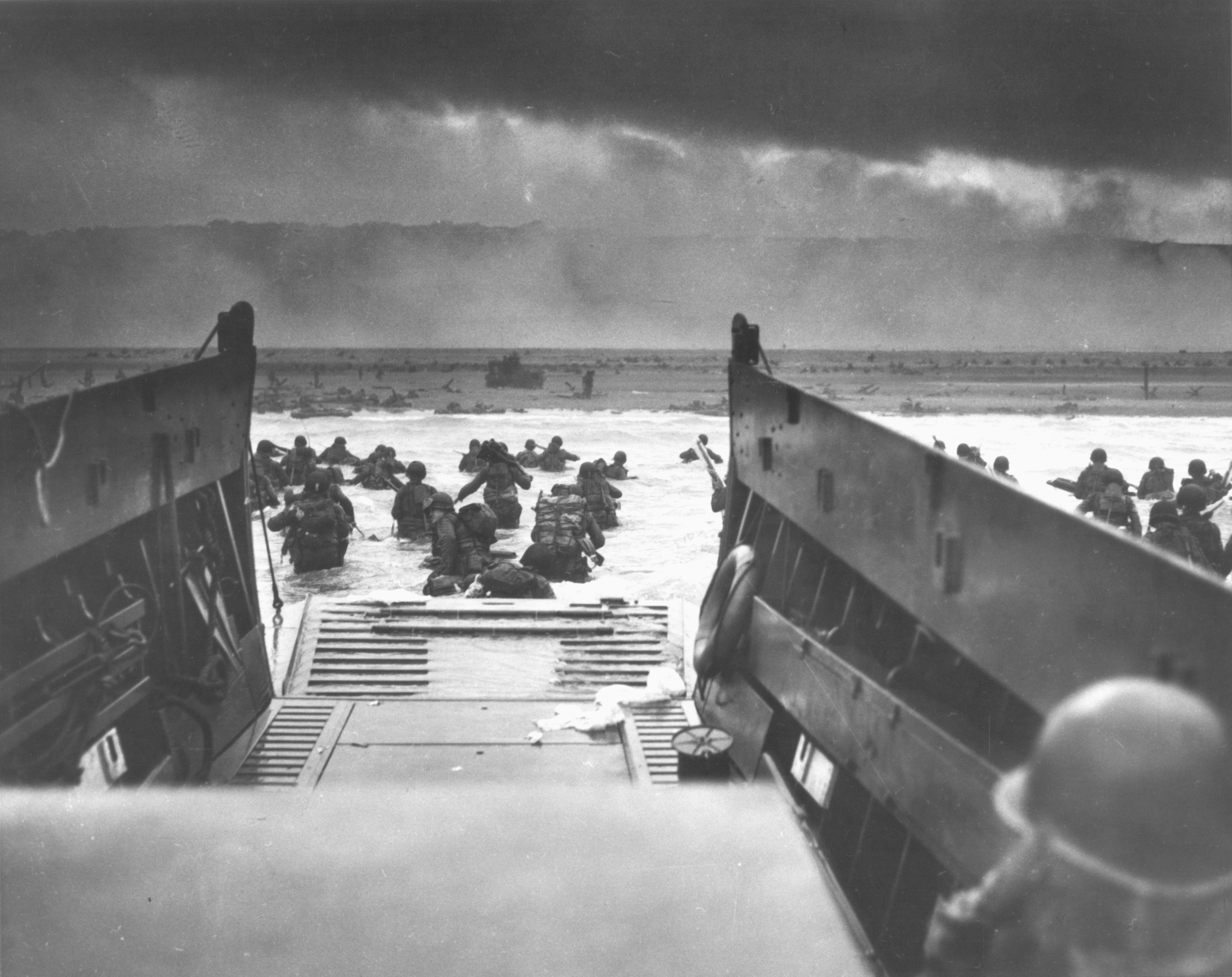
“We’ll start the war from right here.”Brig. Gen. Theodore Roosevelt Jr., Utah Beach, 6 June 1944
07 Normandy & France Summer 1944
Across France
Nels’s first two campaign stars, Normandy and Northern France, cover the fighting from the beachhead through the liberation of France. In Normandy the AAA battalions protected the beaches, the artificial ports, the supply dumps, and the artillery through weeks of hedgerow fighting and nightly air raids.
After the breakout at the end of July, the front became a pursuit: the battalion’s guns rolled with the advance across France through the summer and into the fall, defending bridges, crossroads, and columns as the armies raced toward the German border. The battalion’s month-by-month positions in this period are preserved in its After Action Reports at the National Archives.
With the Checkerboard Division
By the late fall of 1944 the 535th was serving as the attached anti-aircraft battalion of the 99th Infantry Division, the “Checkerboard Division,” named for its blue-and-white shoulder patch. The 99th entered the line on November 9, 1944, taking over a quiet sector of the Ardennes front along the German border between Monschau and Schmidt, a front of nearly nineteen miles, far wider than a division was meant to hold. The 99th had not yet seen battle, and the press nicknamed its men the “Battle Babies.”
Official orders of battle for the period list the 535th AAA AW Battalion among the 99th’s units, alongside its three infantry regiments (the 393rd, 394th, and 395th), its artillery battalions, and the 801st Tank Destroyer Battalion. The sector was cold, snowbound, and deceptively still. On December 13 the division probed the Siegfried Line against heavy resistance. Three days later, the stillness ended.
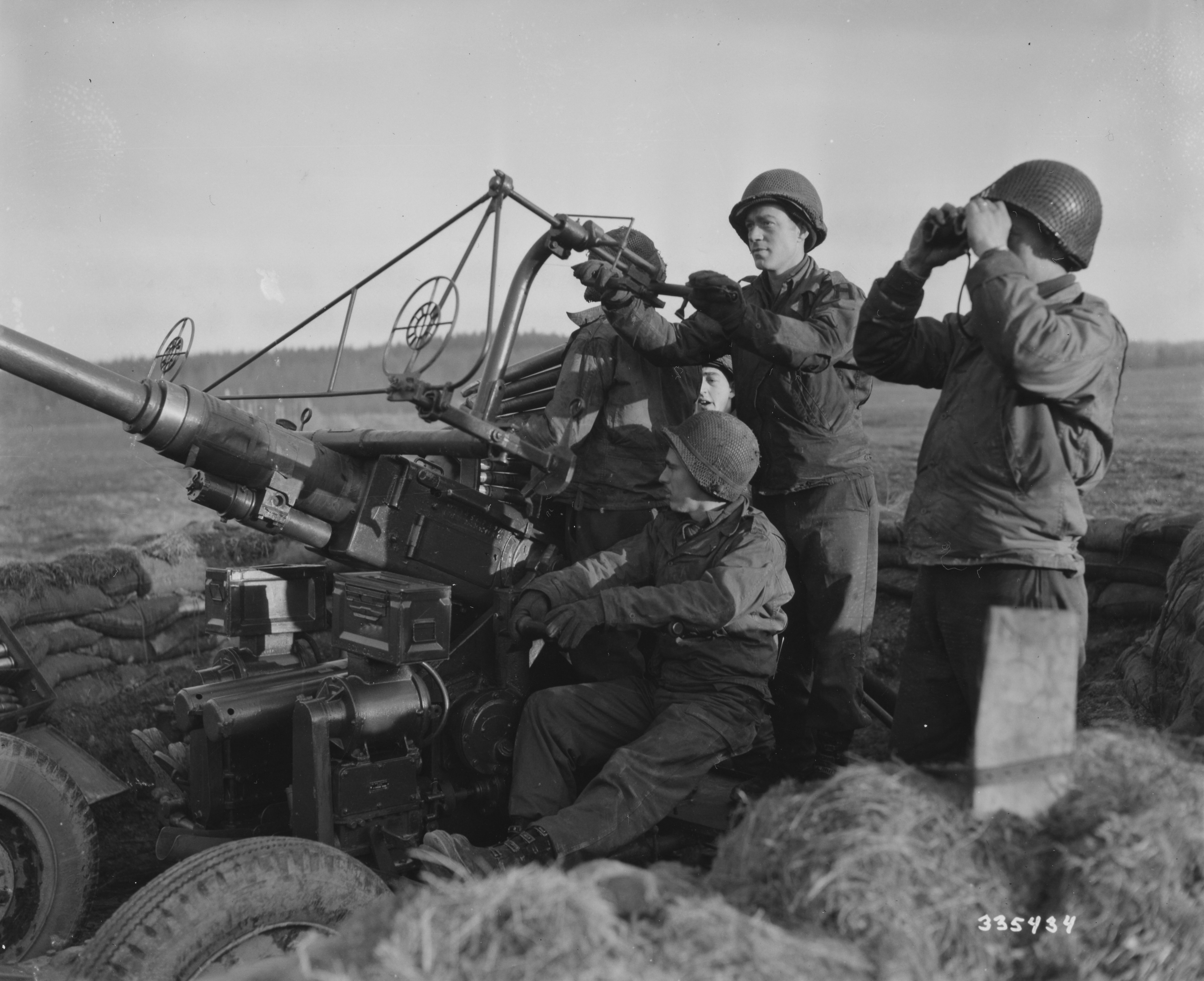
The shoulder that never broke. Elsenborn Ridge, winter 1944–45.
08 The Battle of the Bulge Elsenborn Ridge · Dec 1944
The Shoulder That Never Broke
At 5:30 on the morning of December 16, 1944, the forest in front of the 99th Division erupted. A German artillery barrage crashed along a hundred-mile front, and behind it came the opening assault of Hitler’s last great offensive in the West: the Ardennes counteroffensive, the Battle of the Bulge. The untested 99th, stretched thin on the northern shoulder of the attack, stood squarely in the path of the Sixth Panzer Army, the strongest of the German assault forces.
Though cut up and in places surrounded, the 99th was one of the only divisions on the front that did not yield. Falling back in good order through the twin villages of Krinkelt and Rocherath, the 99th and the veteran 2nd Infantry Division dug into the frozen high ground of Elsenborn Ridge, where the ground was so hard the men needed dynamite to blast foxholes, and there they stopped Sepp Dietrich’s panzers cold. The Elsenborn shoulder never broke. Historians increasingly regard the defense of Elsenborn Ridge, more than the celebrated siege of Bastogne, as the action that wrecked the German timetable and doomed the offensive.
The cost was heavy. The 99th lost roughly twenty percent of its strength: 465 men killed and more than 2,500 evacuated for wounds, injuries, exhaustion, and illness. For the anti-aircraft men of the 535th, the Bulge meant weeks of firing in snow and fog, and when the Luftwaffe mounted its last great air effort over the Ardennes at New Year’s, the battalion’s guns were waiting. Throughout the battle, AAA automatic weapons were also turned against ground targets, the quad-.50s cutting into attacking German infantry.
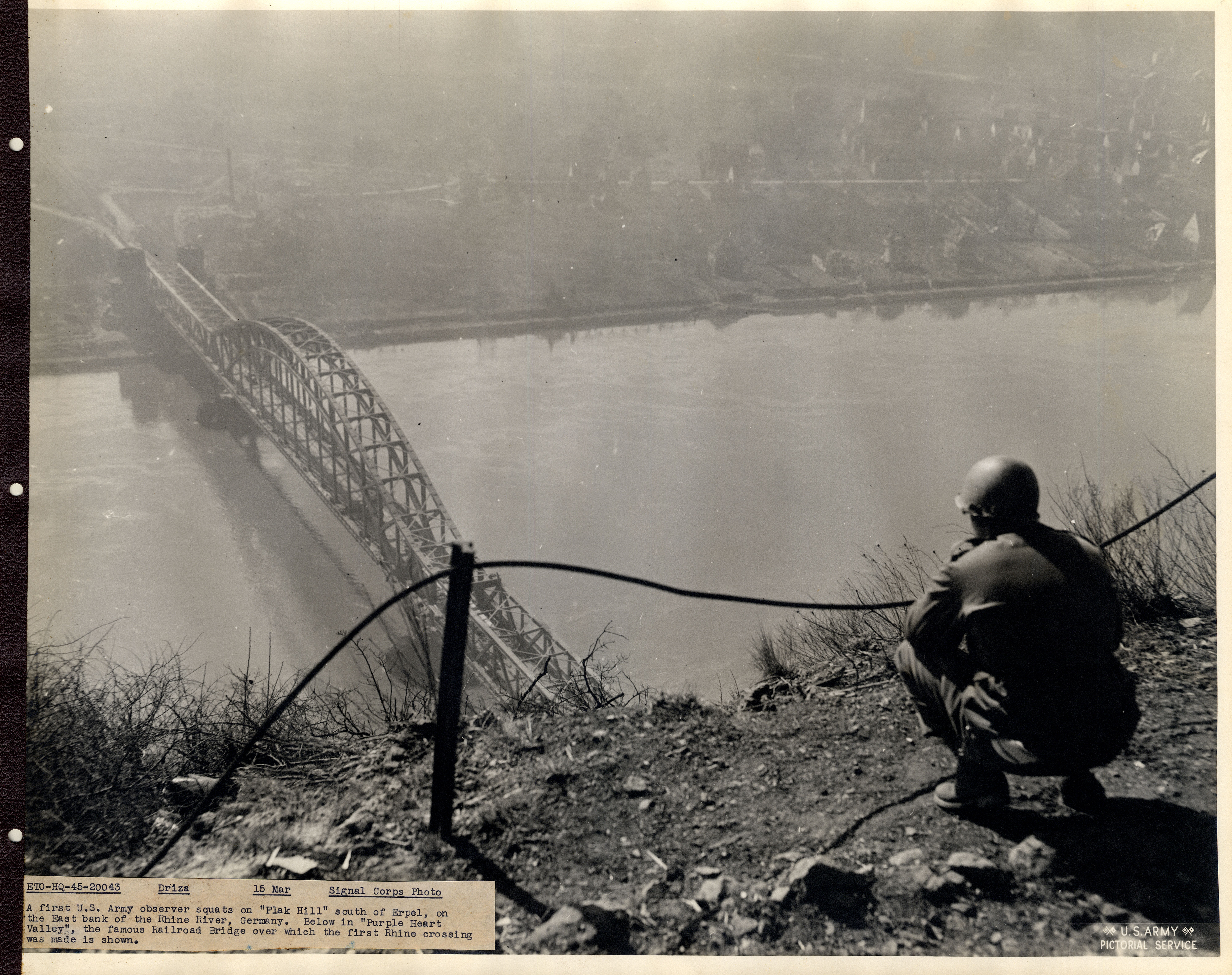
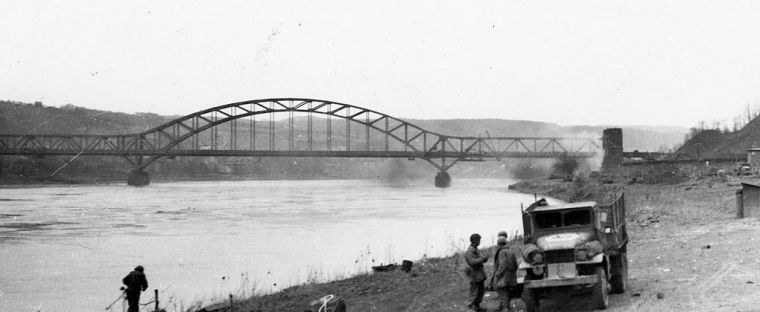
The most-attacked bridge in history. The Ludendorff Bridge at Remagen, March 1945.
09 Remagen The Rhine · March 1945
The Most-Attacked Bridge in History
On March 7, 1945, a task force of the 9th Armored Division found the Ludendorff railroad bridge at Remagen, the last bridge over the Rhine, still standing, and seized it in one of the most storied strokes of the war. For the next ten days the Germans threw nearly everything they had at the bridge: artillery, jet bombers, frogmen, floating mines, a railroad gun, a 540mm siege mortar, and, for the only time against a German target, V-2 rockets.
To keep the Luftwaffe off the bridge, the Americans massed around Remagen the largest concentration of anti-aircraft weapons assembled during the Second World War, producing what has been called the greatest anti-aircraft artillery battle in American history. Over ten days the defenders counted 367 German aircraft attacking the crossing, and claimed nearly a third of them shot down. The bridge was never destroyed from the air.
The 535th’s part is a matter of official record. The U.S. Army’s account of the Remagen bridgehead records the corps order directing that the 99th Infantry Division, with the 535th Antiaircraft Artillery Battalion attached, would cross the Rhine commencing on the evening of March 10, 1945, passing through the 9th Armored Division’s bridgehead and attacking south. Nels Bandy crossed the Rhine at Remagen, at or beside the most famous bridge of the war, under skies his own battalion’s guns helped defend.
10 The Final Drive Rhineland · Central Europe
To V-E Day
Nels’s last two campaign stars carry the story to the end. From the Remagen bridgehead the 99th Division fought south and east, helped seal and reduce the Ruhr Pocket (the encirclement that netted more than 300,000 German prisoners), and drove across Bavaria in the war’s final weeks, crossing the Danube and pushing on until the German surrender on May 8, 1945.
Through it all the 535th’s guns moved with the division, guarding bridges and columns as organized resistance collapsed.
11 Homecoming November 1945
Back to the California Coast
With the war in Europe over, the Army began sending its men home by points, credit for months overseas, campaigns, and decorations. Nels had earned plenty.
He sailed for home and arrived back in the United States on November 10, 1945, and fifteen days later, on November 25, walked out of Fort MacArthur a civilian: twenty-two years old, five campaign stars on his ribbon, back on the California coast where he was born.
Nels had married before he left for the war. He came home to Southern California, and he and his wife raised four children; in the decades that followed, the family grew to nine grandchildren and fifteen great-grandchildren. He spent his later years in the Santa Clarita Valley, north of Los Angeles, and died in Valencia on February 16, 2013, at the age of eighty-nine.
12 Decorations Five stars & the Arrowhead
What He Wore Home
Five campaign stars is nearly the maximum possible for a soldier who landed on D-Day. He was in it from the first campaign to the last.

EAME Campaign Medal
The European–African–Middle Eastern Campaign Medal with five bronze campaign stars, one for each named campaign: Normandy, Northern France, Ardennes-Alsace, Rhineland, and Central Europe.
Bronze Service Arrowhead
A device worn on the EAME campaign ribbon, the arrowhead certifies personal participation in an amphibious assault landing: Utah Beach, June 6, 1944. It is never awarded for arriving later, only for going in with the assault.
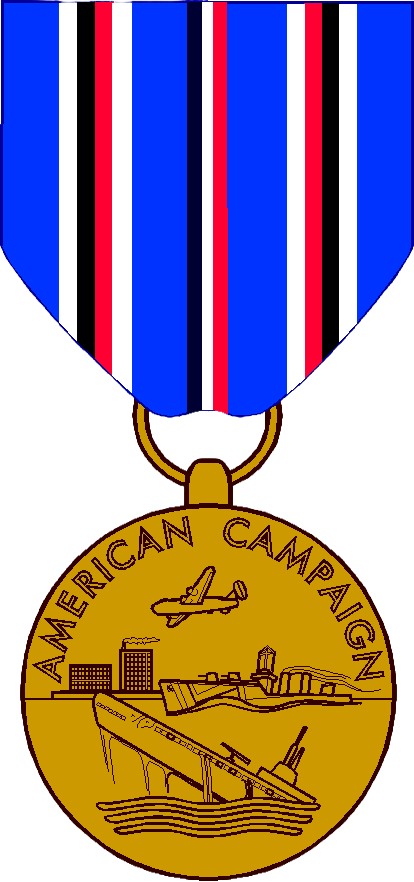
American Campaign Medal
For service in the American theater: his training and duty in the United States before shipping overseas.
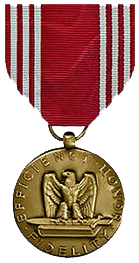
Good Conduct Medal
For exemplary behavior, efficiency, and fidelity in active service.

World War II Victory Medal
Awarded to all who served during the war.
Medal images: public domain via Wikimedia Commons; Good Conduct Medal · CC BY-SA 4.0 via Wikimedia Commons.
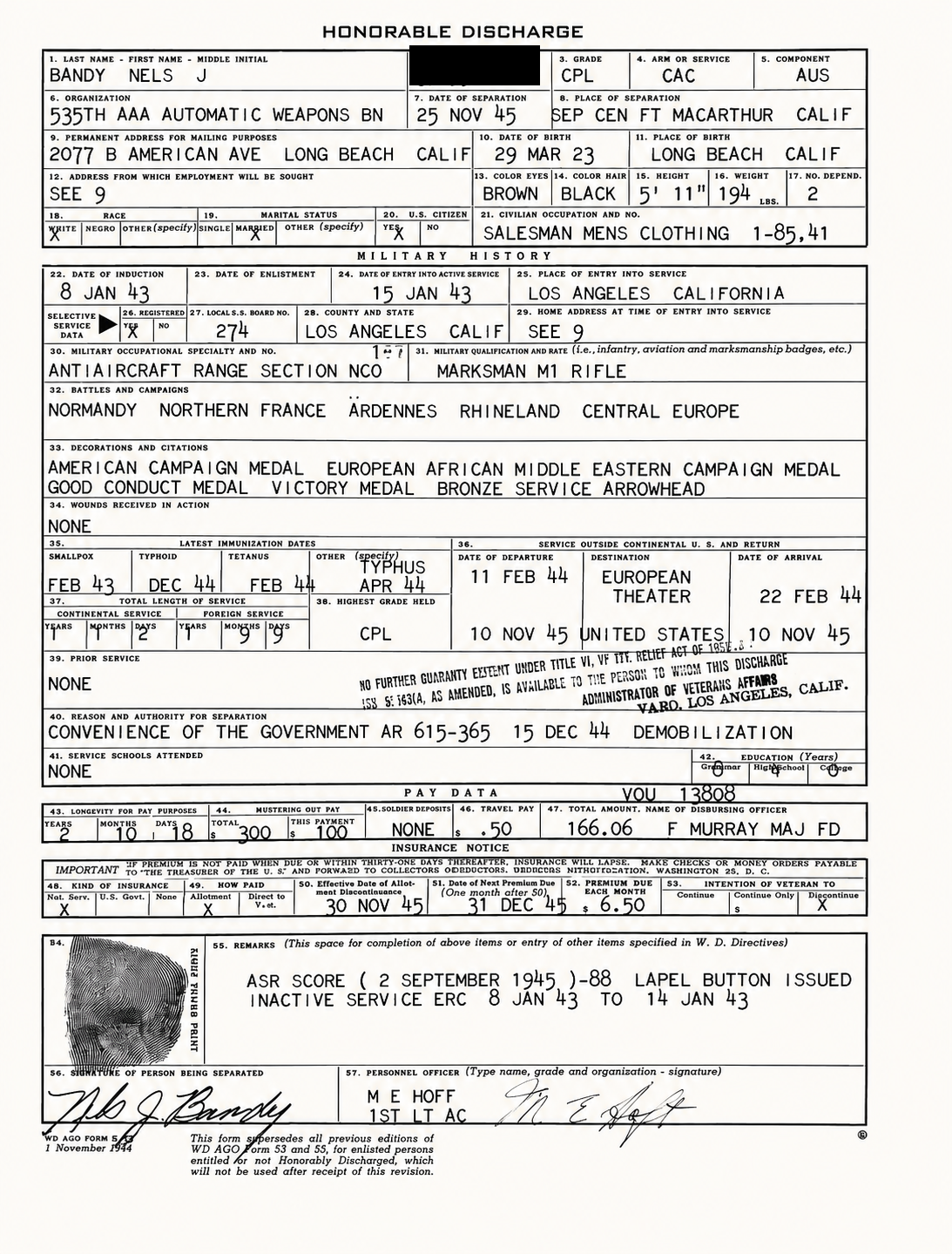
13 The Document WD AGO Form 53-55
The Discharge Record
One War Department form records the whole of his service: rank, unit, campaigns, and the day he came home.
Legacy In memory
Three Hinge Points of a War
Corporal Nels J. Bandy was present, at twenty-one and twenty-two years old, at three hinge points of the Second World War in Europe: the landing at Utah Beach that opened the liberation of France; the stand on the northern shoulder of the Bulge that broke Hitler’s last offensive; and the Rhine crossing at Remagen that opened Germany itself.
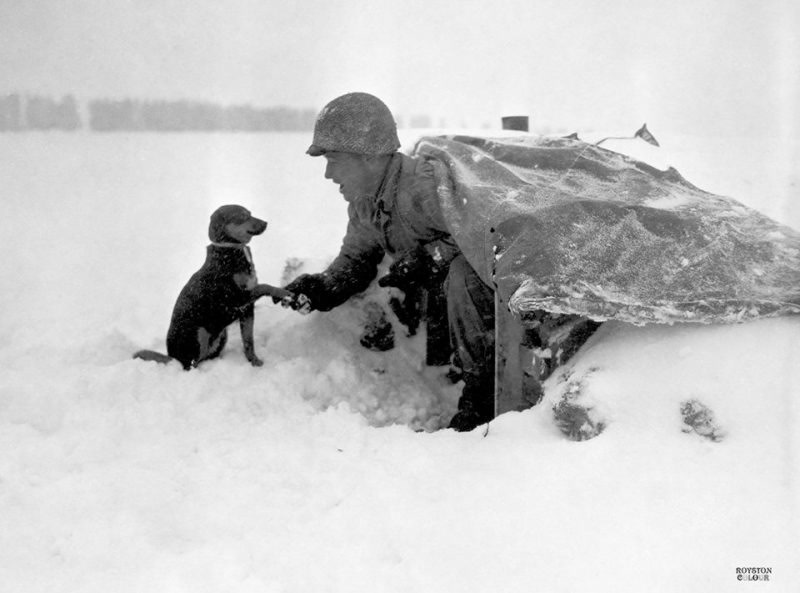
His battalion is remembered in a stone church in Somerset, in the records of the National Archives, in a two-volume unit history written by the men themselves, and in a photograph of one of his comrades sheltering a puppy in the Belgian snow.